Caloia Family | WirelessArchive | De la Rive’s Electric Egg
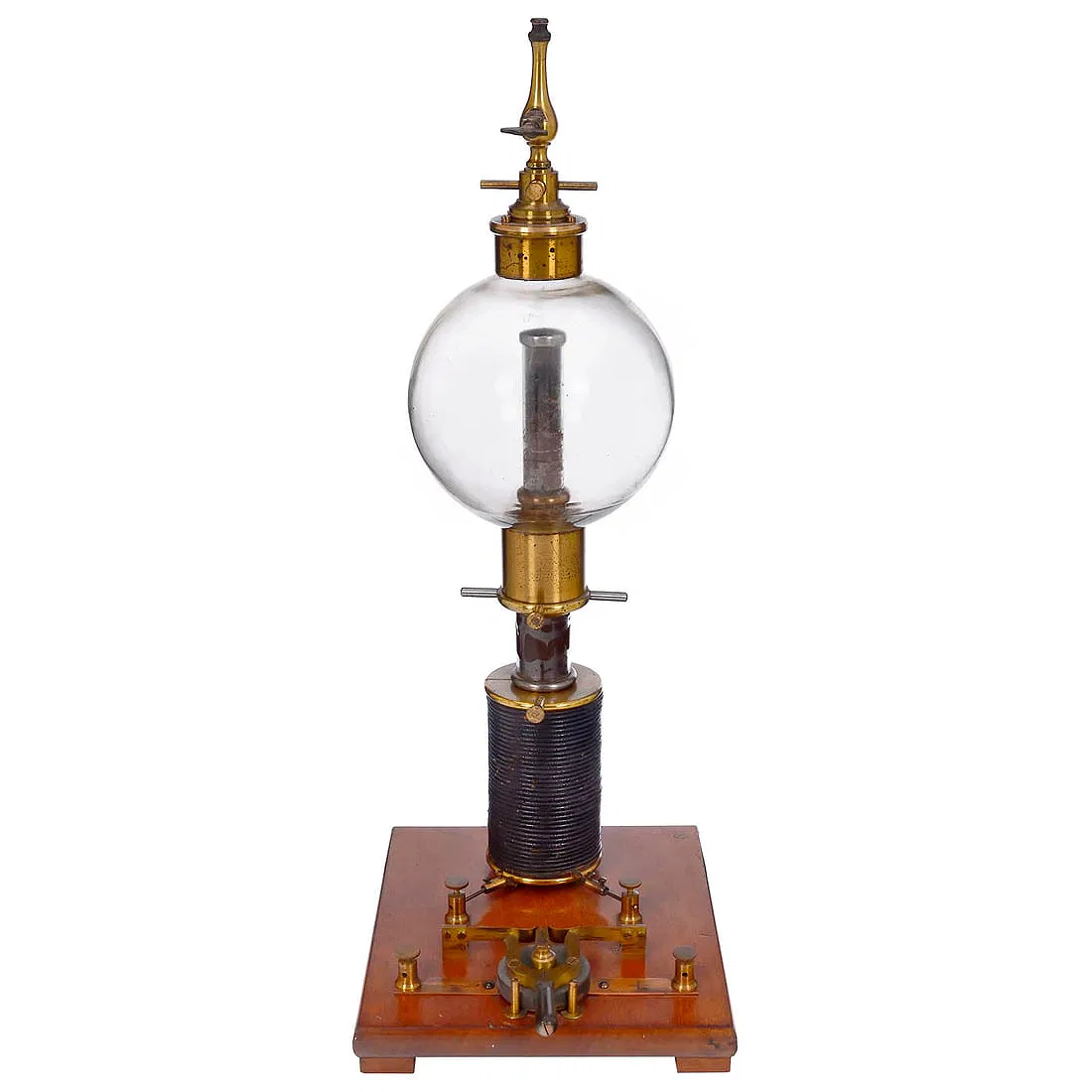
Physical Demonstration Instrument “De la Rive’s Electric Egg”, c. 1880 Made by E. Ducretet, Paris, after de la Rive. Glass sphere with valve, mounted on an electromagnet, polarization switchable, for demonstrating the rotation of currents in a vacuum under the influence of a magnetic field, brass and steel, on mahogany board, 10 x 11 in., total height 26 1/3 in. De la Rive’s electrical studies engaged most of his attention, especially in connexion with the theory of the voltaic cell and the electric discharge in rarefied gases.[3] De la Rive began his scientific labors soon after the new era was opened in the history of electricity and magnetism by the discovery of electro-magnetism, and by Ampere's electro-dynamical theory. His father had a share in this discovery, and his house was visited by others eminent in the same line of research. This may account for the preference which the son early manifested for the study of electricity, and which he continued to cultivate in its manifold relations to the end of his scientific career. Indeed, there are very few among his many printed papers which are upon other subjects.[1] His researches on the subject of electric discharge in rarefied gases led him to form a new theory of the aurora borealis. In 1840 he described a process for the electro-gilding of silver and brass, for which in the following year he received a prize of 3000 francs from the French Academy of Sciences.[3] This and other papers were deemed of sufficient value to be republished in the Annales de Chimie et de Physique or in the Comptes Rendus. The principal work of De la Rive was his Treatise on Electricity in Theory and Practice in three volumes published simultaneously in French and English.[4][5][6] which appeared in the years 1854–58. De la Rive described his theory of the cause of the Aurora Borealis, first published as a memoir in 1854, and illustrated by the experiment, now familiar to physicists, of rotating the voltaic arc of light around the pole of a magnet as any other ponderable conductor would rotate. The Treatise on Electricity was considered "accurate and comprehensive, and is indispensable for the scientific student of electricity".[1]


