US1345754A
Method of manufacturing condensers. William Dubilier's 1918 filing describes mica and foil sections, pressure, impregnation, and insulating compound.
Open local PDF Google Patents recordA compact but heavy eight-section capacitor bank whose reported 0.0072 microfarad, 12,000-volt AC rating closely matches period Signal Corps spark-transmitter design examples.
The strongest claim is not a named radio set. It is that this is a WWI Signal Corps-era high-voltage transmitting condenser battery, very likely for the closed/tank circuit of a spark transmitter.
The reported aggregate value follows from a series-parallel arrangement, with center-tap jumpers tying the branches in two paired groups.
Two equal capacitors in series produce half the capacitance of one capacitor.
0.0036 uF / 2 = 0.0018 uF
Four identical series branches in parallel add together.
4 x 0.0018 uF = 0.0072 uF
The reported aggregate value corresponds to four two-section series branches in parallel. The center-tap jumpers tie the upper two branch midpoints together and the lower two branch midpoints together; with equal sections, the aggregate value remains 0.0072 uF. These two jumpers are visible in the exterior lightbox photographs at the top of the page.
The reported 12,000 V.AC system rating is best treated as the marked aggregate working rating. It is lower than the ideal arithmetic sum of two 8,500 V units in series, which is normal for conservative high-voltage design.
Dubilier's reputation came from using mica as a compact, stable dielectric for radio condensers at a time when Leyden jars were bulky and fragile.
Dubilier's patent described alternating metal foil and mica layers held under pressure, an approach suited to compact high-voltage condensers.
Text pages 18-20 of Dubilier's The Wonderful Achievements of Radiotelegraphy in War and Peace give the period explanation for why mica replaced Leyden jars in high-voltage radio service.
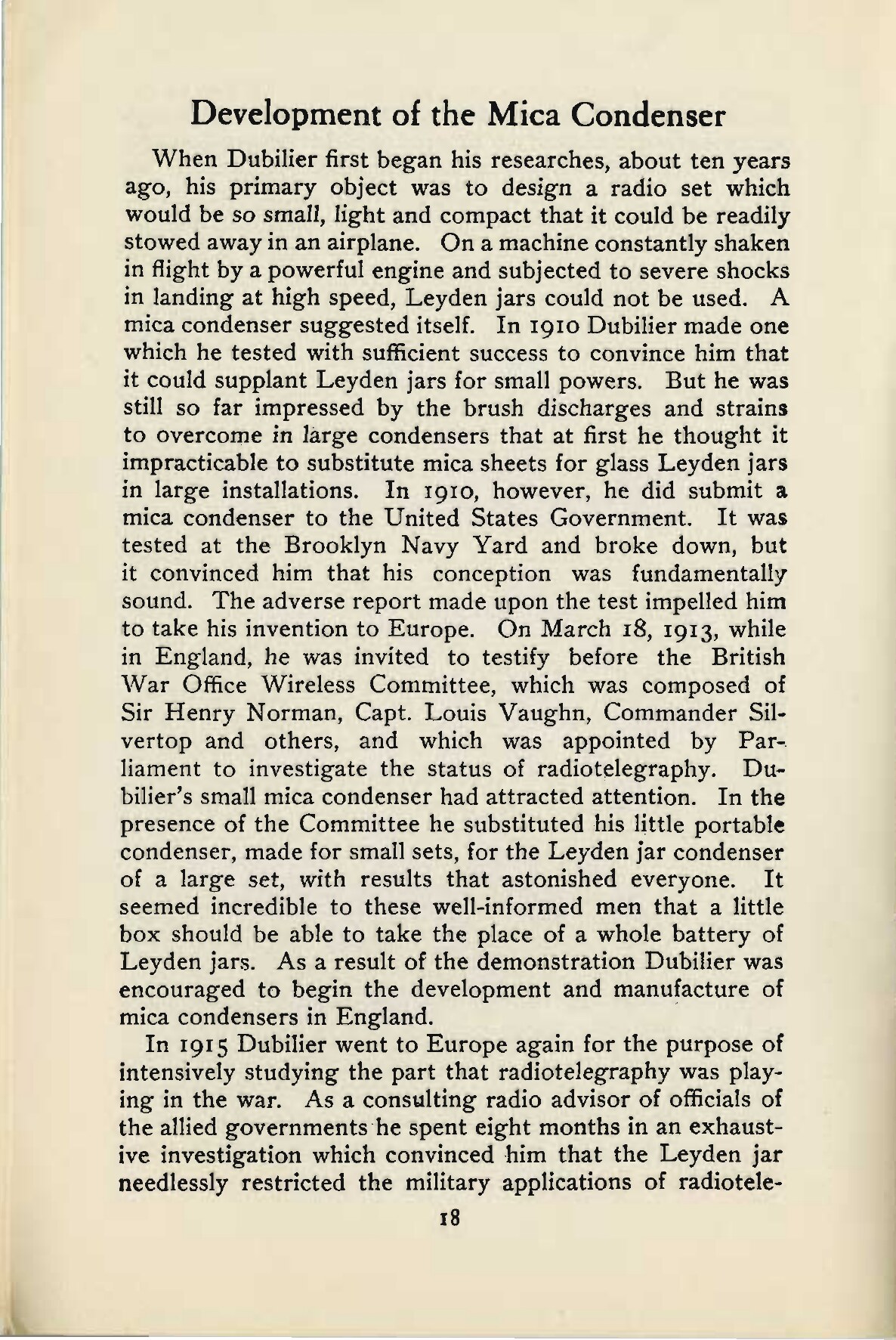 Page 18
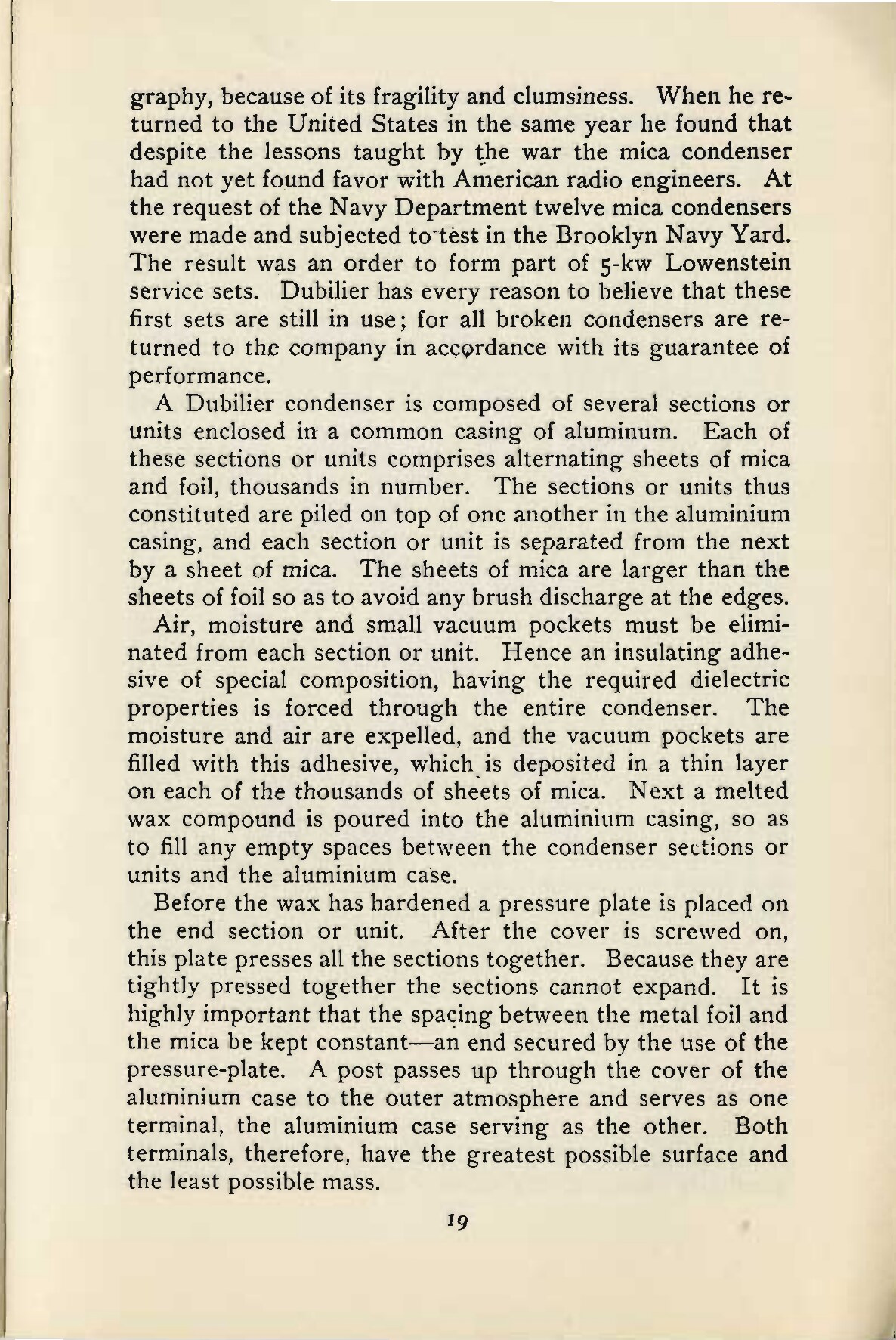 Page 19
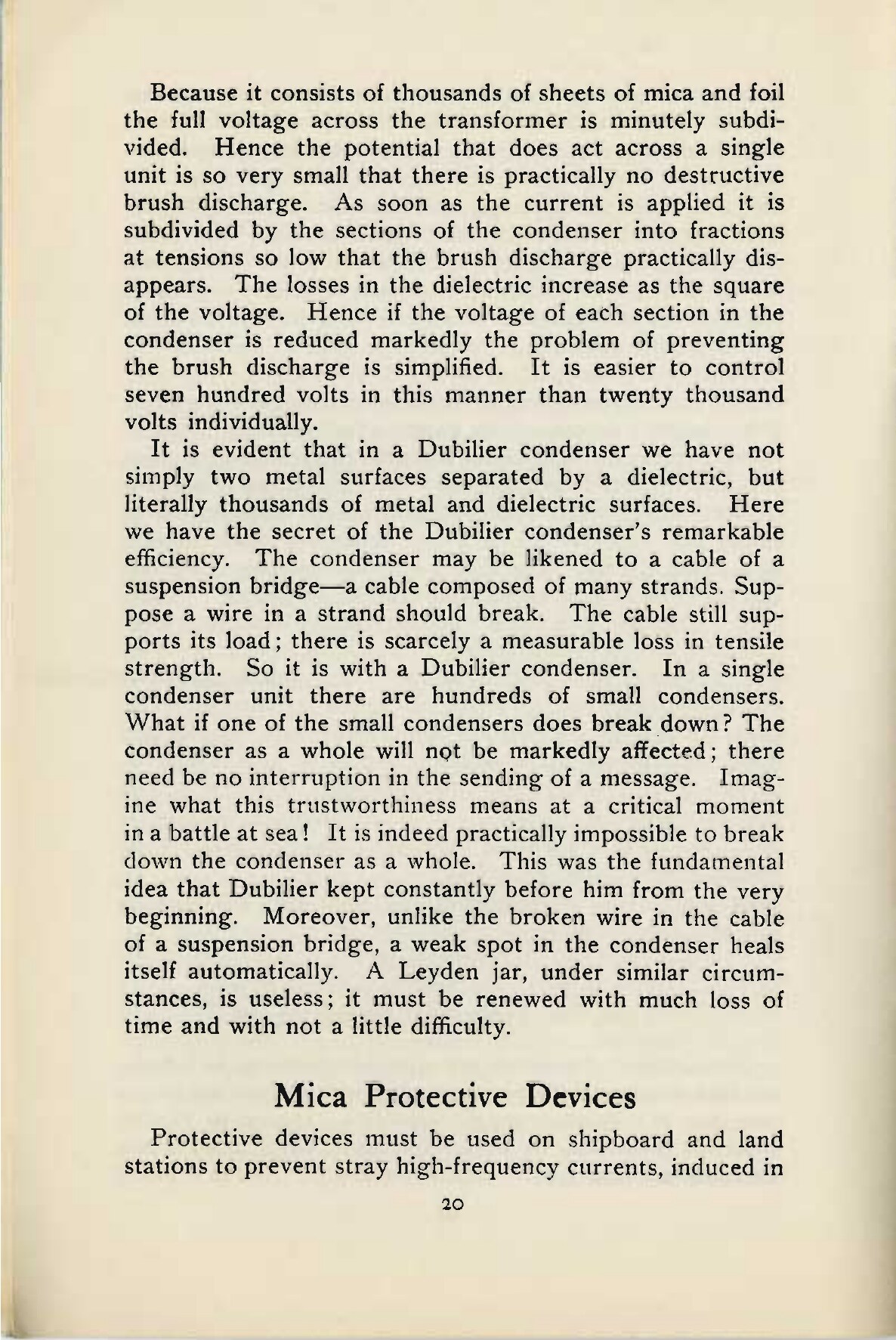 Page 20
Local archived copy: The Wonderful Achievements of Radiotelegraphy in War and Peace PDF.
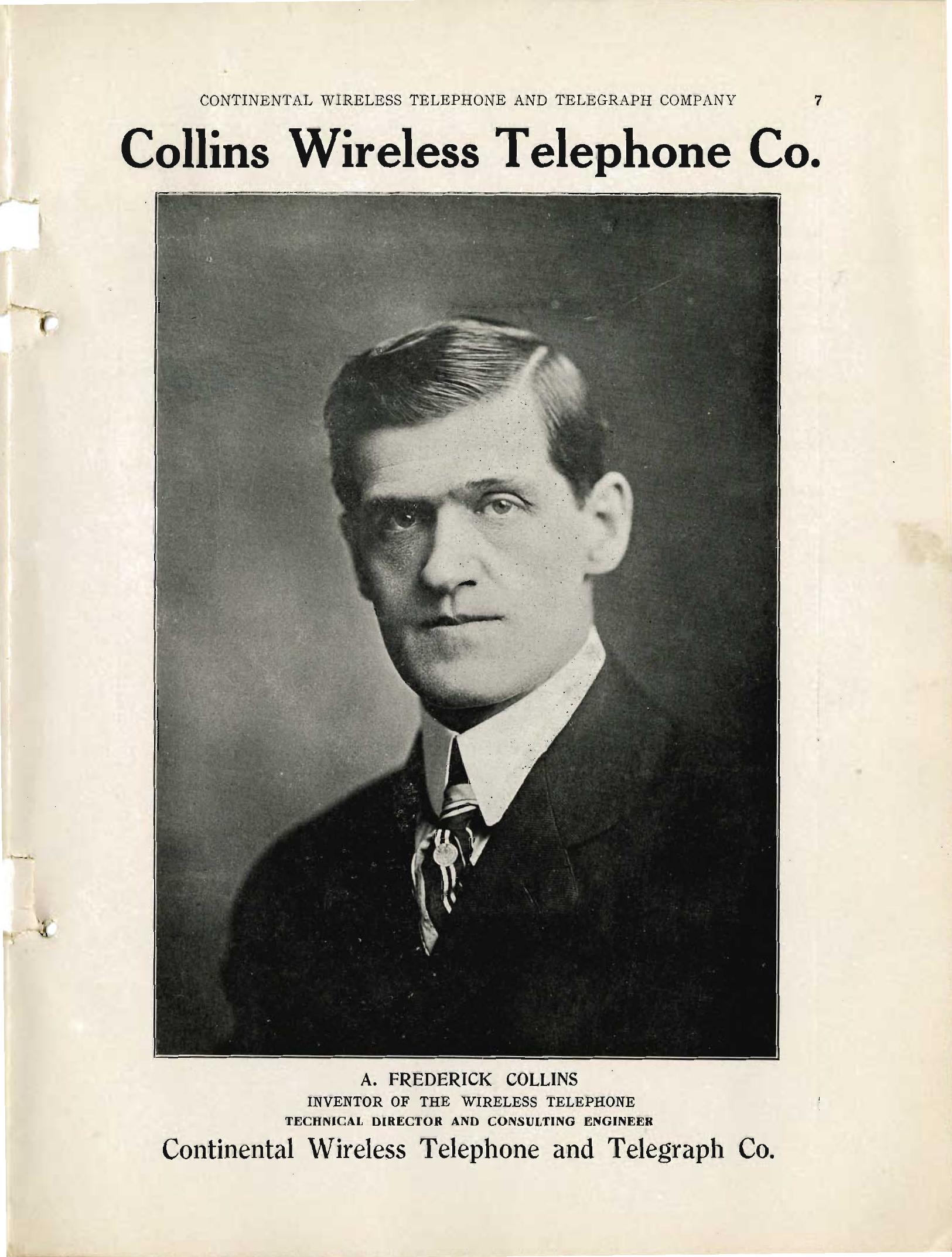
John Jenkins of the SPARK Museum supplied an important lead: Dubilier's public 1909 Seattle wireless-telephone story sits inside an earlier Collins Wireless Telephone Company context.
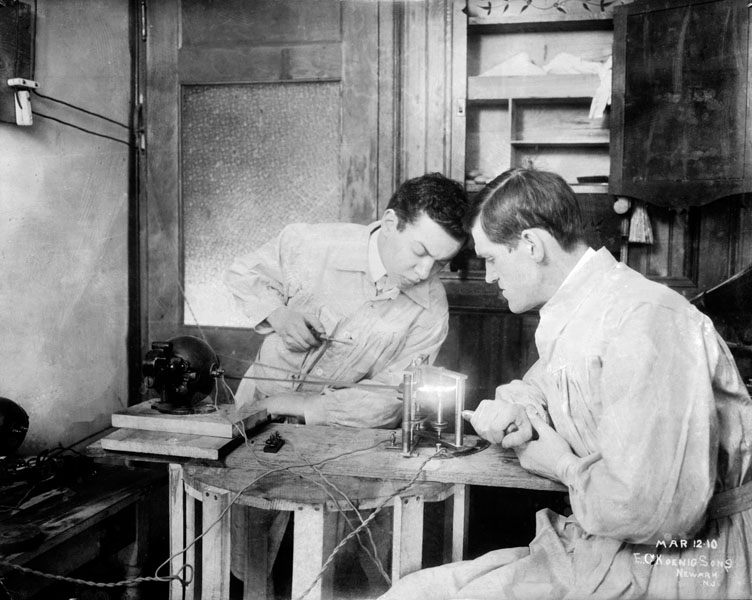
In a June 2, 2026 note, John Jenkins reported that William Dubilier worked as A. Frederick Collins's assistant as a youth, and that he has photographs of Collins and Dubilier working on both the Collins wireless telephone and rotating arc telephony apparatus.
Jenkins also reported that Collins sent Dubilier to Seattle for the Alaska-Yukon-Pacific Exposition demonstration, then told him not to return; Dubilier remained in Seattle and continued improving the wireless telephone while postal authorities were moving against the Collins/Continental wireless promotion.
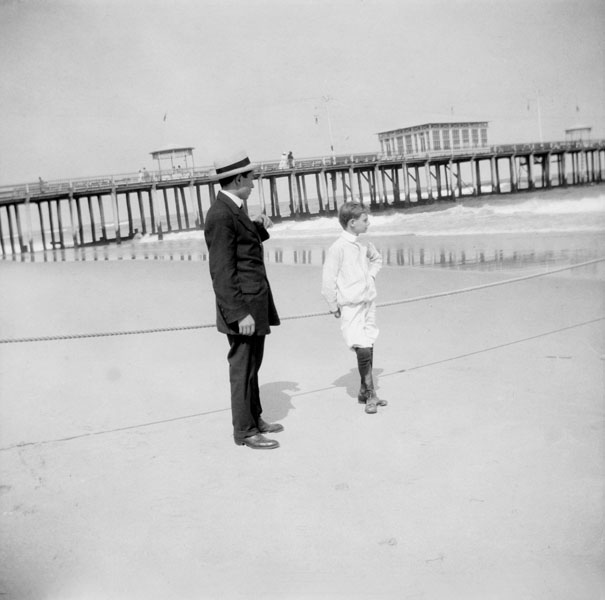
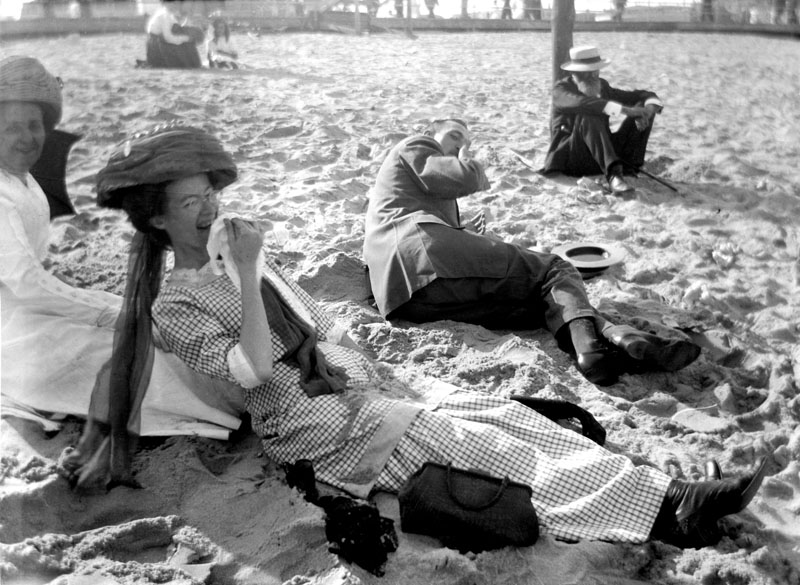
In a June 3, 2026 follow-up, Jenkins supplied three Collins-related Dubilier photographs, including a dated March 12, 1910 image of Collins and Dubilier working with a rotating oscillation arc.
 Source page
This does not diminish Dubilier's later condenser work. It sharpens the chronology: before the 1918 Signal Corps condenser, Dubilier was already deeply involved in radiotelephony demonstrations, arc-transmitter work, and the transition from bulky Leyden-jar apparatus to compact mica condensers.
Ira Goldklang's Faradon lead checks out as a real condenser-history connection, but not as proof that F.R.P.S. means "Fellow of the Royal Photographic Society."
There is also a later corporate link: in 1949, Cornell-Dubilier announced that it had purchased RCA's Faradon Capacitor Division, including the Faradon trademark, tools, equipment, designs, processes, and patent licenses. That is a postwar business connection, not evidence about the origin of this 1918 Signal Corps condenser.
These local patent PDFs document the mica/foil condenser construction and the June 12, 1917 patent date reflected in the condenser-patent trail.
Method of manufacturing condensers. William Dubilier's 1918 filing describes mica and foil sections, pressure, impregnation, and insulating compound.
Open local PDF Google Patents recordElectrical condenser. William Dubilier's high-tension condenser patent was issued June 12, 1917 and assigned to Dubilier Condenser Co.
Open local PDF Google Patents recordElectrical condenser. Philip Dubilier's companion condenser patent was issued June 12, 1917 and also assigned to Dubilier Condenser Co.
Open local PDF Google Patents recordThe reported plate date falls at the end of World War I, during a fast transition from spark-gap transmitters toward vacuum-tube transmitters.
These are the claims that should stay out of a final museum label until a document, marking, or catalog page supports them.
Source statements were used narrowly. When the artifact itself supplied a value, that value is labeled as owner-reported.