Norton Air Force Base
Local reference page expanded from the California State Military Museum source provided for militarymuseum.org/NortonAFB.html.
History by Richard E. Osbourne
This base began before the war as Municipal Airport, San Bernardino under Army Air Corps jurisdiction. During the summer of 1941 it became a training base to support the 30,000 Pilot Training Program, and within days of Pearl Harbor combat-ready fighters arrived to defend the Los Angeles area.
In July 1942 the airport was renamed San Bernardino Army Air Field and the San Bernardino Air Depot was established there. Wartime operations centered on aircraft repair and maintenance, while the Air Transport Command used the field and gas-turbine maintenance was added in 1943.
After the war that engine work helped make the base one of the Air Force’s major jet-engine maintenance centers. The installation transferred to the new U.S. Air Force in 1948 and in 1950 was renamed for Capt. Leland Norton, who died over France after ordering his crew to bail out from his crippled aircraft.
Later missions included missile logistics, military airlift, and audiovisual support. The base was selected for closure through the BRAC process and shut down in 1994, with the last remaining mission elements departing in 1995.
History by Justin Ruhge
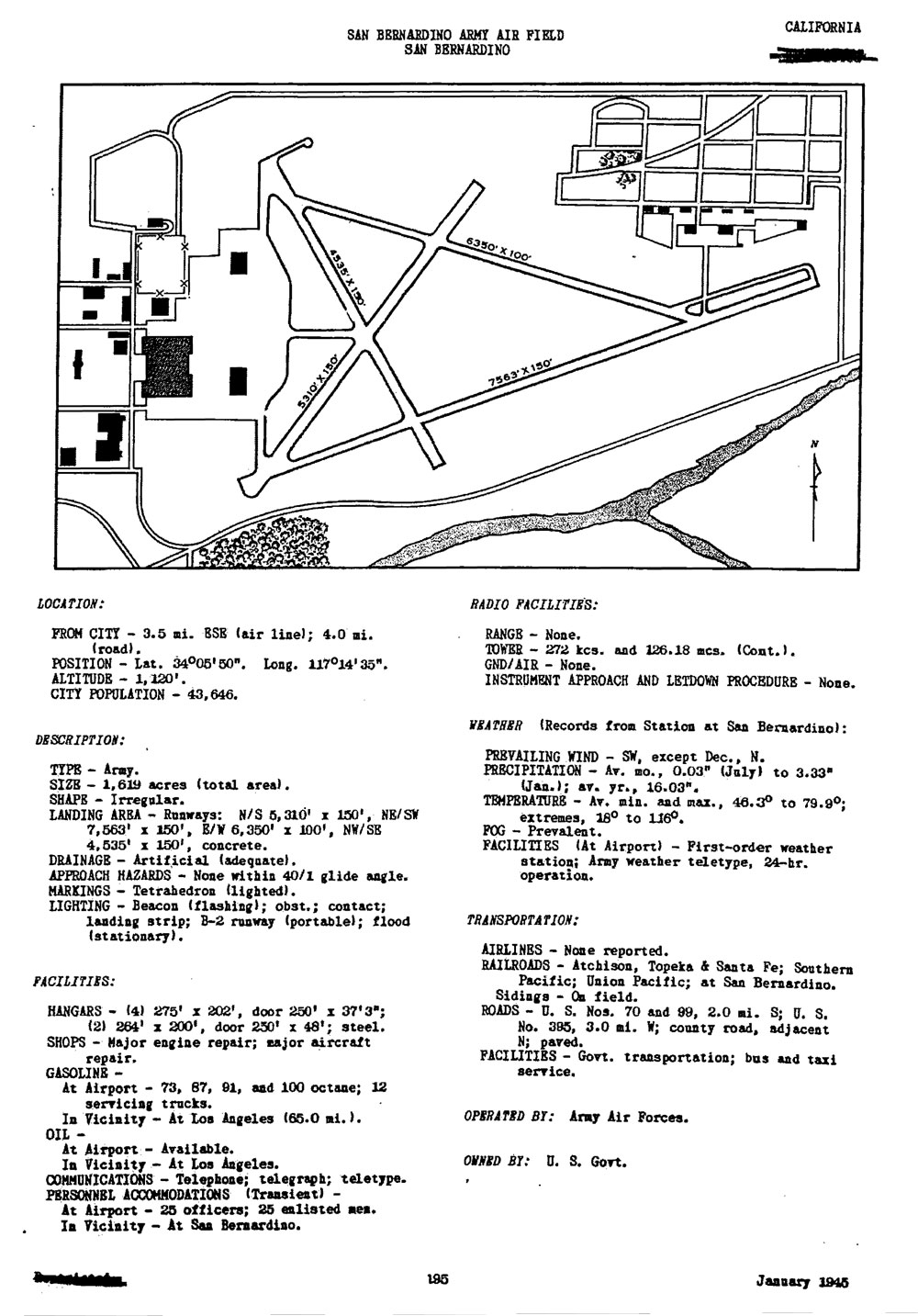
The San Bernardino Municipal Airport was located three miles southeast of San Bernardino. Construction of Army flight-training facilities began in March 1942, the first unit arrived in May, the first aircraft landed in June, and all four runways were in service by December 19, 1942. Night flying began on March 13, 1943, and facilities for overhauling gas-turbine engines were completed in mid-1943.
The installation became San Bernardino Air Field on December 24, 1947, San Bernardino Air Force Base on January 13, 1948, and finally Norton Air Force Base on March 2, 1950. Jet overhaul began in 1951, and by late 1953 the base had become one of the Air Force’s three jet-overhaul centers. The runway was lengthened to 10,000 feet and high-thrust test cells were completed in 1954.
The base later served as a logistic support and storage point for Titan and Atlas missiles, opened a new MAC passenger terminal in 1969, and continued major improvements into the 1970s, including hydrant fueling and tower rehabilitation.
Operational Summary
Norton operated for most of its life as a logistics, depot, and heavy-lift transport installation. Major secondary missions included southern California air-defense headquarters functions in the 1950s and 1960s, the Air Force Audio-Visual Center, reserve airlift organizations, and later military and space-missile support offices.
In 1966 the base shifted from Air Force Logistics Command to Military Airlift Command, becoming one of the service’s principal strategic airlift bases. It later passed into Air Mobility Command. After closure, the aviation facilities were converted into today’s San Bernardino International Airport.
Leland Francis Norton
Norton Air Force Base was named for San Bernardino native Capt. Leland Francis Norton (1920-1944). During his sixteenth combat mission, near Amiens on May 27, 1944, his A-20 was hit by antiaircraft fire. After ordering his crew to bail out, Norton remained with the aircraft and was killed.
Selected Major Commands
- Fourth Air Force, 1942
- Air Service / Technical Services / Materiel commands, 1942-1966
- Military Airlift Command, 1966-1992
- Air Mobility Command, 1992-1994
Selected Major Units
- 11th Station Complement
- 499th Base Headquarters and Air Base Squadron
- San Bernardino Air Materiel Area
- 63rd Military Airlift Wing
- 445th Military Airlift Wing
- Air Force Audio-Visual Center
December 1945 Inventory Snapshot
- Total acreage: 1,828 acres
- Enlisted capacity: 4,046
- Officer capacity: 198
- Station hospital capacity: 150
- Total covered storage: 2,090,000 sq ft
- Total open storage: 941,000 sq ft
- Total government cost since July 1, 1940: $27,396,629