
Download printable Pilot Guide booklet (PDF)
Tanks Planes
DTC Patch

THE DTC
SKY TRAIL

PILOT GUIDE

PILOT'S KNEEBOARD EDITION

Disclaimer

The information contained within these pages is intended to be strictly and solely ADVISORY in nature. It may contain errors and omissions, and is likely to be out of date. It should not be used for navigational purposes nor construed as being in compliance with 14 CFR. Use of this information is solely your responsibility.

All pilots in command are required by 14 CFR § 91.103 to, "before beginning a flight, become familiar with all available information concerning that flight." For this guide, obtain current operational information from official aviation sources.

By using this document, you agree to take full and exclusive responsibility for your actions and hold harmless all parties involved in making this information available.

Your use of this document affirms your agreement to the above statement.
Flight Information Introduction

All pilots in command are required by 14 CFR § 91.103 to, "before beginning a flight, become familiar with all available information concerning that flight." For this guide, obtain current operational information from official aviation sources.

The terrain surrounding the DTC/C-AMA is rugged and mountainous, with elevations ranging from sea level to nearly 12,000 feet. The Sky Trail itself is approximately 150 nautical miles, although you may find yourself traveling much farther by exploring the camps more closely. Count on spending at least three hours for the tour. There is no fuel available along the route. Fuel can be obtained in Laughlin, Needles, or Kingman to the north; and Twentynine Palms, Thermal, and Blythe in the south.

Many of the features are visible only from certain angles and altitudes, requiring some experimentation and exploration. In most of the divisional camps (except Camp Young), the most distinctive features are the headquarters circle, where a flagpole would have been placed. These indicate the administrative centers of the camps. The roadways and rock-lined walkways are visible from low altitude (500 AGL), while the larger outlines of the camp can only be seen from higher altitudes, several thousand feet AGL. Be aware, however, of the obstructions in the area, including towers at Rice and Essex. Power lines do not have the eye-catching colored balls, and some lower obstructions are not charted.

To the west of the Sky Trail route, the R-2501 restricted areas are unlimited in altitude and continuous in operation. Although a good-sized portion of the DTC/C-AMA resides under R-2501, viewing it by aircraft is not practical. The tour steers well clear of this area, so watch your position, especially near Cadiz. Remaining north of the railroad tracks will help ensure you stay out of R-2501.

Weather Concerns

Because air over the solar-heated desert floor warms rapidly, it becomes less dense and buoyant, rises, and can generate significant convective turbulence. Plan your flight for the cooler months, October through March. If you fly the Sky Trail during other months, depart as early in the day as possible. After 1300 local time, low-level convective turbulence is likely to make for a very uncomfortable ride and can complicate in-flight photography. In summer, afternoon thunderstorms are frequent. While individual storms can include violent updrafts, downdrafts, and hail potential, they are seldom widespread enough to completely block a route. More often, you may need to deviate around storm areas or wait for cells to move or dissipate. Fall, winter, and spring are generally cooler and less turbulent. Keep in mind that desert temperatures can drop sharply after sunset, especially in winter; for a forced-landing contingency, carrying reflective “space blankets” is prudent.

Wind-generated turbulence can also be a problem in this mountainous desert terrain. If the surface winds are forecast or reported to be greater than 10 knots, it would be prudent to choose another day for your Sky Trail experience.

Low Level Operation

All pilots in command are required by 14 CFR § 91.103 to, "before beginning a flight, become familiar with all available information concerning that flight." For this guide, obtain current operational information from official aviation sources.

The pilot must acknowledge the dangers of flying into the ground or an obstruction while viewing objects on the ground that are sometimes challenging to see, so it is best if the pilot concentrates solely on flying the aircraft to enable the passengers to view the surface features. It is recommended that 500 feet AGL be an absolute minimum altitude for safe operations, and that 1,000 feet AGL is probably more prudent.

Obstructions

There are charted towers near Rice and Essex that extend several hundred feet above the surface. There are also electrical transmission lines near many of the camps. There may also be uncharted obstructions, so use good judgment when flying near the surface (14 CFR § 91.119). Be sure to request the current altimeter setting from Riverside Radio or ATC.

Off-Airport Landings

Landing off-airport or on private airstrips without prior permission is trespassing.

Emergencies

Carry an emergency kit and a warm jacket in your airplane. Your kit should contain aerial flares and smoke signals, a signal mirror, reflective Mylar “space blankets,” and practical first-aid supplies appropriate to your operation. Carry plenty of drinking water for emergency use and while en route on the Sky Trail, with at least one gallon per person as a planning baseline. This desert area is very sparsely populated and assistance can be a great distance from a forced landing site. If you are forced down, stay with your aircraft, or, if you are certain you can do so safely, attempt to stop a motorist on a nearby road. Activate your ELT. Attempt to contact any aircraft you see or hear on the emergency frequency, 121.5 MHz. It will be cold at night in the desert, so keep warm in a sheltered place with the Mylar blankets and layers of clothes. Cellular telephone service in this area can be unreliable; do not count on it.

Airspace

All pilots in command are required by 14 CFR § 91.103 to, "before beginning a flight, become familiar with all available information concerning that flight." For this guide, obtain current operational information from official aviation sources.

Because you will be flying from 600 to 1,000 feet AGL, much of this route is within 3,000 feet of the surface, where the hemispherical cruising-altitude rule (14 CFR § 91.159) generally does not apply during low-level segments. If your operation places you above 3,000 feet AGL in level cruising flight, use proper hemispherical VFR cruising altitudes for your direction of flight. Most of the campsites along the Sky Trail lie under Class G airspace, which lies under Class E airspace with a floor of 1,200 feet AGL. Although there is no requirement to be in communication with ATC in this airspace, it is essential to contact Riverside Radio for the current status of Military Operations Areas (MOA), Military Training Routes (MTR), and other special-use airspace at the time of your flight.

You may generally contact Flight Service on 122.2 MHz where coverage is available. Use current Sectional Charts and the Chart Supplement U.S. (formerly A/FD) to confirm the nearest usable Flight Service frequencies and outlets for your route.

Restricted Areas

To the west of the Sky Trail route, the R-2501 Restricted areas are unlimited in altitude and continuous in operation. Because a good-sized portion of the DTC/C-AMA resides under R-2501, viewing it by aircraft is not practical. The tour steers well clear of this area, so watch your position, especially near Cadiz. Remaining north of the railroad tracks and east of the road will help ensure you stay outside R-2501.

Military Operations Areas (MOA)

Before flight, obtain current MOA status from Flight Service, NOTAMs, and current charts. MOA status can change rapidly. VFR flight is not prohibited in an active MOA, but conflict risk may be elevated; before entry, contact the controlling agency for advisories whenever available. MOA floors near the Sky Trail are often above planned tour altitudes, but transiting military traffic can still be a factor.

Military Training Routes (MTR)

All pilots in command are required by 14 CFR § 91.103 to, "before beginning a flight, become familiar with all available information concerning that flight." For this guide, obtain current operational information from official aviation sources.

Military Training Routes present one of the highest collision risks on this route. Military aircraft may operate at very high speed and can be extremely difficult to detect visually in time to avoid conflict due to closure rate, low contrast, and geometry. Although 14 CFR § 91.113 applies to all pilots, practical see-and-avoid limits are significant in this environment. Regardless of published schedule status, request real-time ATC services (VFR flight following) whenever available, and obtain current route-use information from Flight Service before departure and as needed in flight. In joint-use airspace, route or altitude changes may be prudent based on advisories and conditions, but are not automatically required solely because an MTR exists.

Near Chiriaco Summit VR1257 and VR289
Near Desert Center VR1265 and VR296
Near Rice VR206 and VR296
Near Cadiz VR1265 and VR289
Near Goffs VR1225, VR289, and VR296
Near Ibis VR1265

The Aeronautical Information Manual (AIM 3-5-2) advises that MTRs are generally established below 10,000 feet MSL for high-speed military training operations, with route structure and operating rules varying by route type. VFR Military Training Routes (VR) are flown under VFR with specific visibility and ceiling constraints; use current AIM text and Flight Service information for complete, current criteria.

Key AIM 3-5-2 planning points:

Communications

AIM 4-1-9 describes self-announce procedures: pilots broadcast position and intentions on the designated CTAF/UNICOM frequency at non-towered airports. For this route, verify the current CTAF/UNICOM frequencies from current charts and the Chart Supplement U.S. before flight.

Federal Aviation Regulations (14 CFR)

14 CFR § 91.103 (Preflight action): each pilot in command shall, before beginning a flight, become familiar with all available information concerning that flight, including weather, fuel requirements, alternatives, and known traffic delays as applicable. Consult the current regulation text for complete requirements.

Fuel Availability Advisory

As of February 22, 2026, Amboy/Roy’s (NXP) is generally reported to have fuel available (attendant-operated pumps), but hours can vary and the location is remote, so do not treat fuel there as guaranteed for flight-critical planning. Verify same day by calling Roy’s at 760-733-1066 and confirm current status through official aviation sources.

14 CFR § 91.119 (Minimum safe altitudes) applies throughout this route. In addition to terrain and obstacle clearance, maintain legal separation from persons, vessels, vehicles, and structures, and plan altitudes that preserve safe emergency landing options.

14 CFR § 91.151 (Fuel requirements for flight in VFR conditions): plan required reserves conservatively for forecast winds, reroutes, and sightseeing segments at low altitude.

The DTC Sky Trail Route

All pilots in command are required by 14 CFR § 91.103 to, "before beginning a flight, become familiar with all available information concerning that flight." For this guide, obtain current operational information from official aviation sources.

The table on the following page provides the pilot with the GPS coordinates of the campsites. The Magnetic Course, Distance, and En Route Altitude to the next waypoint are shown, as well as the approximate elevation of the campsite location, and typical minimum en route altitude for overflight to the next camp. When overflying the campsites, slow down and deploy some flap to reduce stall speed. The en route speed shown is typical of light, single-engine aircraft, and may be used to judge when to slow down, and when to expedite flight to the next waypoint.

Flight Plan

WaypointLatitudeLongitudeApprox. ElevMag Crs (to Next)NMAltKIAS
Young CampN33º 40.4’W115º 47.0’1,713’084º32,700’80
Chiriaco SummitN33º 39.9’W115º 42.6’1,713’062º222,700’80
Desert CenterN33º 44.9’W115º 19.4’559’004º141,700’100
Camp CoxcombN33º 55.1’W115º 15.7’300’029º112,000’100
Camp GraniteN34º 03.3’W115º 06.9’400’075º41,000’80
Rice Army AirfieldN34º 04.0’W114º 48.9’250’067º21,000’80
Camp RiceN34º 04.4’W114º 46.2’250’261º444,500’Cruise
Camp Iron MountainN34º 06.0’W115º 09.5’400’317º181,500’Cruise
CadizN34º 31.9’W115º 29.1’800’024º183,500’Cruise
Camp ClipperN34º 45.85’W115º 16.06’2,000’037º182,450’80
Essex AirfieldN34º 46.3’W115º 13.2’2,000’079º22,450’80
Camp EssexN34º 47.91’W115º 16.07’2,000’304º33,500’100
GoffsN34º 55.1’W115º 4.2’2,600’054º123,500’100
Ibis AirstripN34º 58.54’W114º 50.39’2,000’074º23,500’80
Camp IbisN34º 58.2’W114º 49.4’2,000’038º123,500’Cruise
LaughlinN35º 09.28’W114º 33.56’700’Land
1 Camp Young
(N33º 41’ / W115º 47’) Inbound Mag Crs: 084°, altitude: 2,700’, 80 KIAS

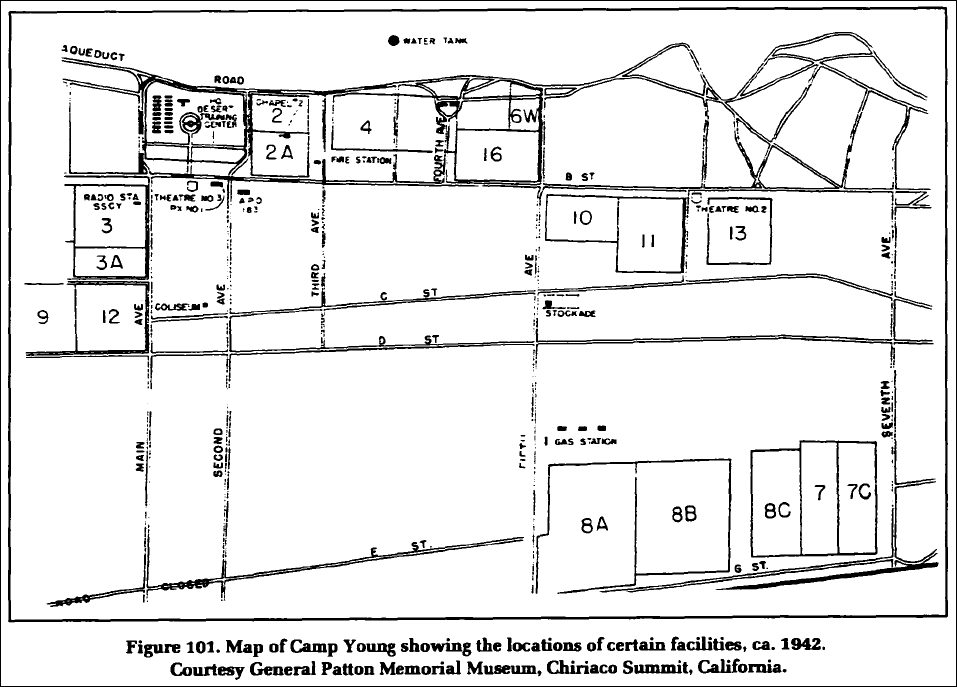
As your flight approaches the airport at Chiriaco Summit from the west, you will see the street pattern of Former Camp Young against the foothills north of Interstate 10, 3 NM west of the airport.

2 Shaver’s (Chiriaco) Summit
(N33º 40’ / W115º 43’) Inbound Mag Crs: 077º, altitude: 2,700', 80 KIAS

As your flight departs Camp Young and proceeds easterly through the Chuckwalla Valley, you follow the prominent Colorado River Aqueduct and transmission lines north of Interstate 10.

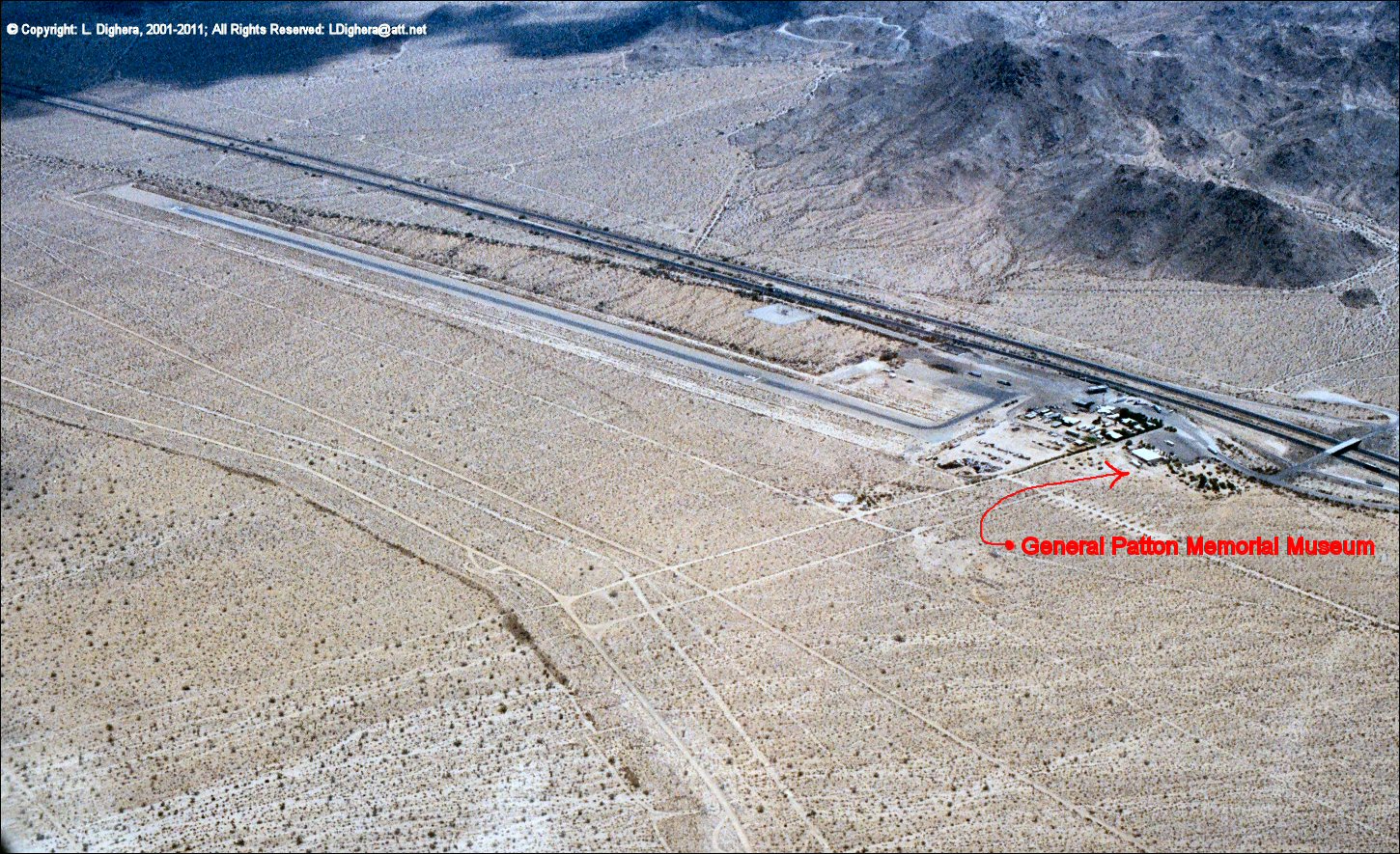
You may land at Chiriaco Summit Airport (L77) and visit the General Patton Museum (as listed on the museum website as of February 25, 2026: open daily 9:30 to 4:30; phone: (760) 507-4143), or dine at the Chiriaco Summit Coffee Shop. Admission and schedule details can change, so verify current details before planning a stop. You may also visit the General Patton Army Airfield, L77. Announce your position and intentions on the Common Traffic Advisory Frequency (CTAF) of 122.900 MHz. There are no facilities or fuel available at the Chiriaco Summit Airport.

3 Desert Center
(N33º 45’ / W115º 15’) Inbound Mag Crs: 356º, altitude: 1,700’, 100 KIAS

Once you pass the mountains to the north, you will see the vast expanse of the Palen Valley to the north and east. If you look carefully to the south just north of Interstate Highway 10 where it intersects with Eagle Mountain Road, you may be able to discern the road pattern of the Desert Center Evacuation Hospital site. The Desert Center Evacuation Hospital site remains in good condition today, and retains the same basic design and layout of divisional camps, although it is much smaller.

As you progress northward, you will soon pass Desert Center Airport (CN64), another former DTC air facility. CN64 is generally private-use and should be treated as unavailable for routine public operations unless prior permission has been obtained. If operating near the airport environment, use current published CTAF/traffic frequencies from official sources and make standard position reports as appropriate.

Desert Center Observer’s Camp was established immediately north of the small town of Desert Center.

18th Ordnance Battalion Campsite, and its 50,000-gallon water tank and wooden tower, was located 5 miles east of Desert Center, adjacent south of the airport.

Quartermaster Truck Site: A rock alignment for the 496th Medium Ordnance Company spells out “496 MEDCO.”

4 Camp Coxcomb
(N33º 55’ / W115º 16’) Inbound Mag Crs: 028º, altitude: 2,000’, 100 KIAS

Turning north to follow California Highway 177, climb to 1300 feet MSL (600 feet AGL) as you progress up the valley from Desert Center. You will find Camp Coxcomb located west of the highway, along the eastern foothills of the Coxcomb Mountains, along which the Metropolitan Water District aqueduct is sited. The camp is located about five miles north of the point where the highway makes an abrupt bend to the north. Slow down and circle the street pattern of the camp. If you look closely, you will see the relief map and altar. The faint remains of the 4,200' long Coxcomb airstrip is located on the east side of California Highway 177 across from the northern portion of the campsite.

5 Camp Granite
(N34º 03' / W115º 07') Inbound Mag Crs: 339º, altitude: 1,000’, 80 KIAS

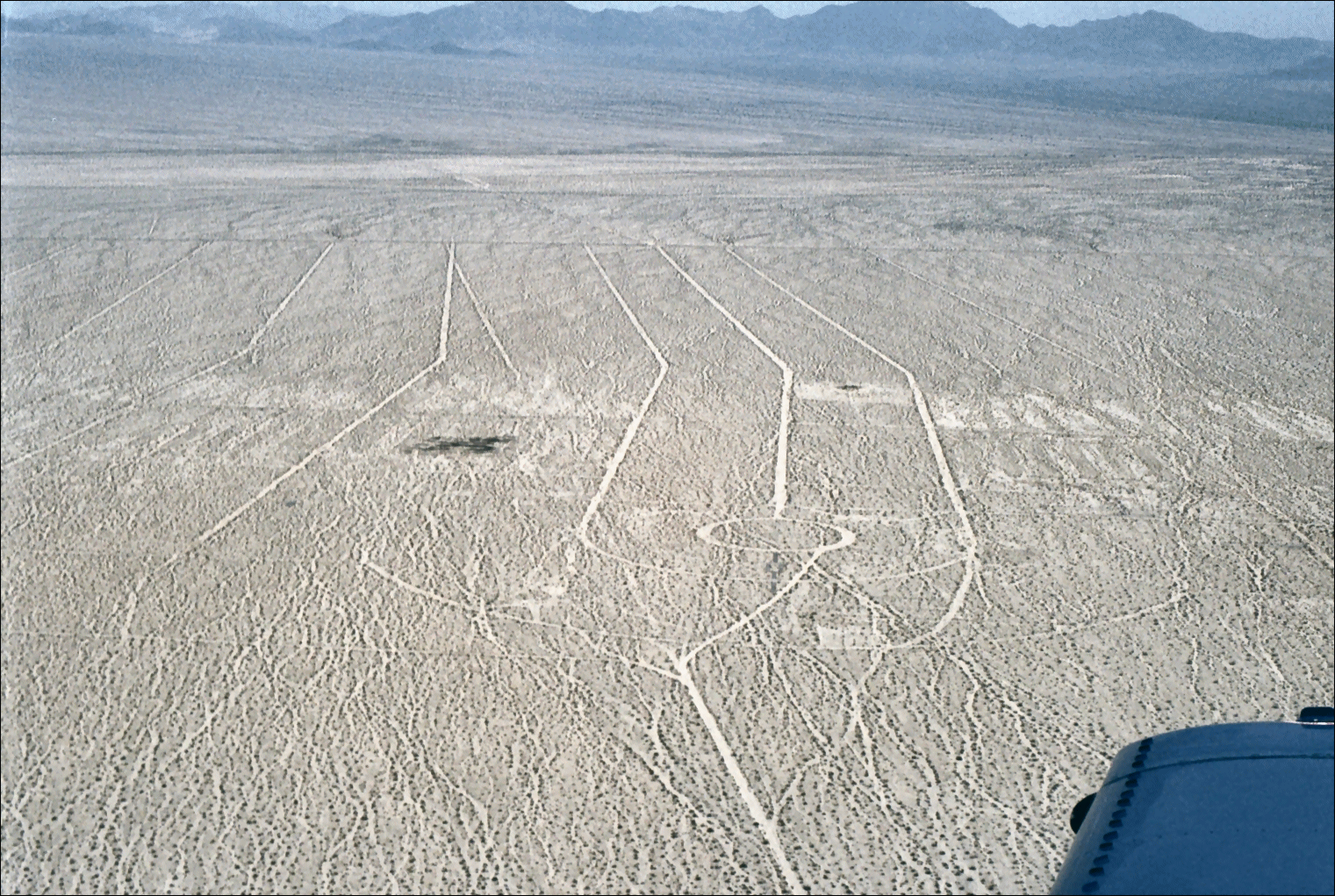
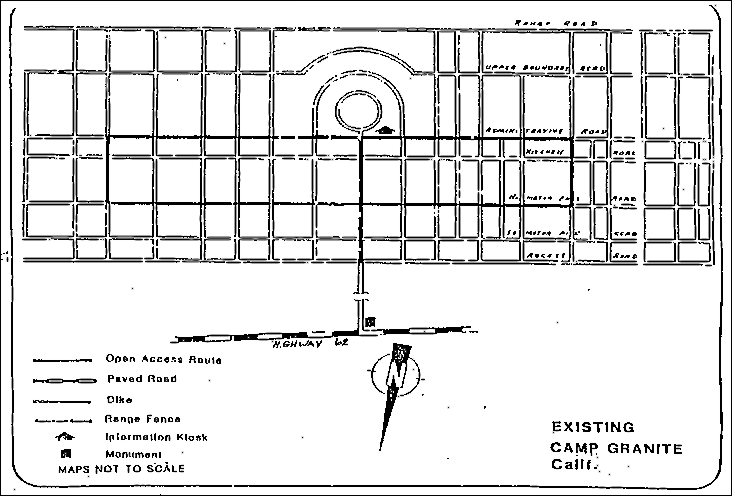
Continuing to follow California Highway 177 northward brings you to Camp Granite located on the northern foothills of the Granite Mountains and south of California Highway 62 and aqueduct. The original camp was closer to the highway, but, because of flooding, was moved up-slope to the south, closer to the mountains. Adjacent northwest is the 484th Quartermaster Battalion campsite.

6 Rice Army Airfield
(N34º 04' / W114º 49') Inbound Mag Crs: 065º, altitude: 1,000’, 80 KIAS

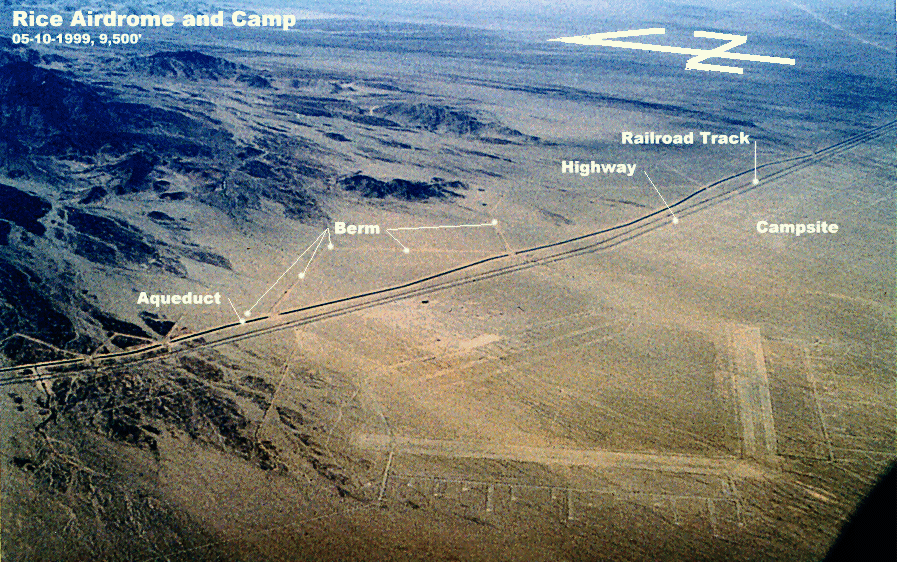
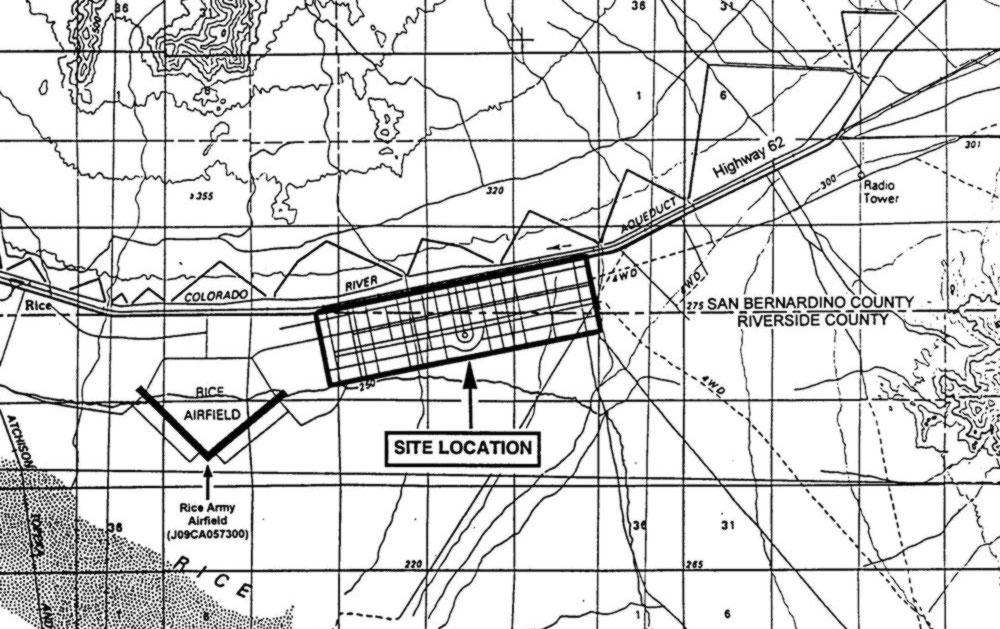
Proceed eastbound past the former Rice Army Airfield site; do not plan to land there. Although Rice historically had paved runways, the airfield is abandoned and the former runway surfaces are no longer maintained or reliable for normal aircraft operations. Treat the site as unavailable for routine use; unauthorized landing or ground access may constitute trespass. In the Rice–Essex corridor, remain vigilant for hazards including charted towers, transmission lines, and possible uncharted obstacles. Freeman Field survey reference (historical condition photos/descriptions): https://www.airfieldsfreeman.com/CA/Airfields_CA_Riverside_E.htm. Use current official aviation sources for operational decisions.

7 Camp Rice
(N34º 05' / W114º 46') Inbound Mag Crs: 296º, altitude: 4,500’, Cruise

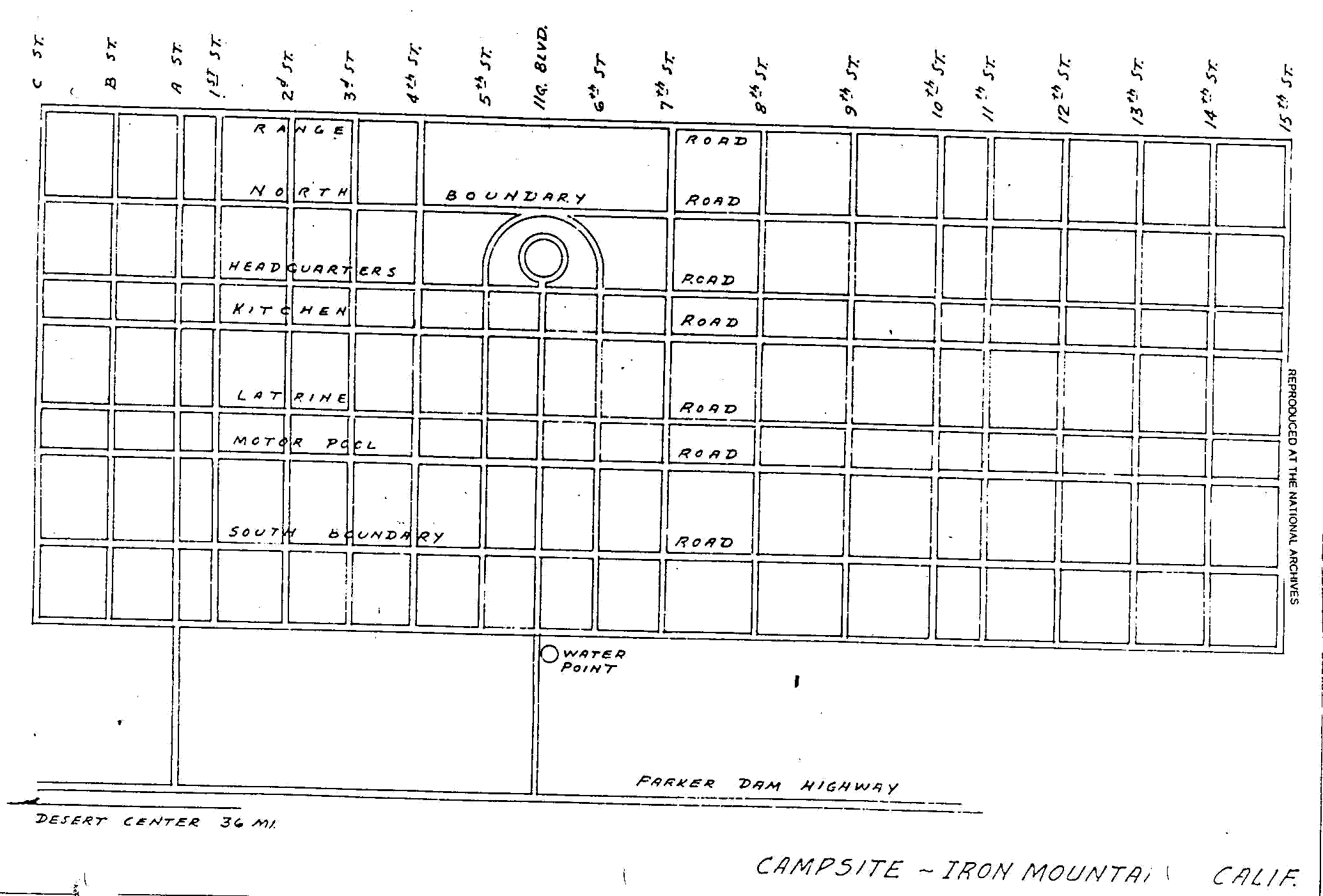
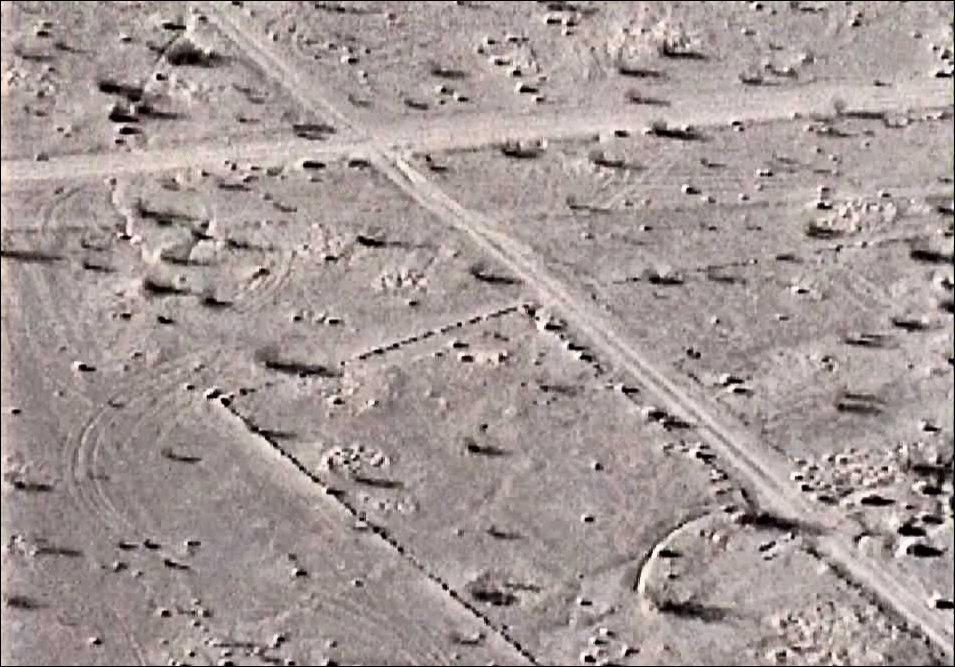
Camp Rice is easiest to identify by its rectilinear street grid and rock-lined walkways east of the former Rice AAF site. Use a stable orbit at conservative speed and configuration, keeping the site on one side of the aircraft while maintaining obstacle clearance and continuous outside scan. If contrast is poor due to sun angle or haze, do not descend to improve visibility; continue to the next waypoint or re-approach from a different heading. In this corridor, remain alert for towers, transmission lines, and possible uncharted wires. Verify all airspace and obstruction information with current charts, NOTAMs, and Flight Service before flight.

8 Camp Iron Mountain
(N34º 06’ / W115º 10') Inbound Mag Crs: 084º, altitude: 1,500’, Cruise

As you proceed westbound toward Camp Iron Mountain beyond the junction of California Highways 177 (north-south) and 62 (east-west), the Colorado River Aqueduct in this segment runs north-south along the eastern foothills of the Iron Mountains and provides a useful visual reference. Camp Iron Mountain lies west of the aqueduct and west of private Metropolitan Water District Iron Mountain Pumping Plant Airport 72CL (formerly 8L6).

The camp contains clear street outlines, many rock alignments and insignias, two rock-and-cement altars, and the DTC/C-AMA’s largest topographical map. The BLM fenced much of the site to protect it from vehicle traffic.

9 Cadiz
(N34º 32' / W115º 28') Inbound Mag Crs: 024º, altitude: 3,500’, Cruise

Cadiz was a Santa Fe Railroad siding where the Army leased 600 feet of track. Supplies and equipment were unloaded at Goffs or sent farther down the line at Rice. Today, the Cadiz area includes foundations, rock alignments, and an abandoned railroad siding that are visible from the air. Cadiz Airstrip (CA90), about 1 NM south of Cadiz, is private-use and should be treated as unavailable for routine public operations unless prior permission has been obtained. The broader Cadiz Ranch area includes agricultural development, with multiple grape-vineyard blocks readily evident.

10 Camp Clipper
(N34º 45.85' / W115º 16.06') Inbound Mag Crs: 037º, altitude: 2,450', 80 KIAS

Camp Clipper appears to have been a temporary camp used primarily as a staging area when one division was moving in and another was moving out. Evidence of the camp is now sparse, and many original surface features have faded or been disturbed. Look for faint remnants of the street pattern and related ground traces.

11 Essex Airfield
(N34º 47' / W115º 13') Inbound Mag Crs: 079º, altitude: 2,450', 80 KIAS

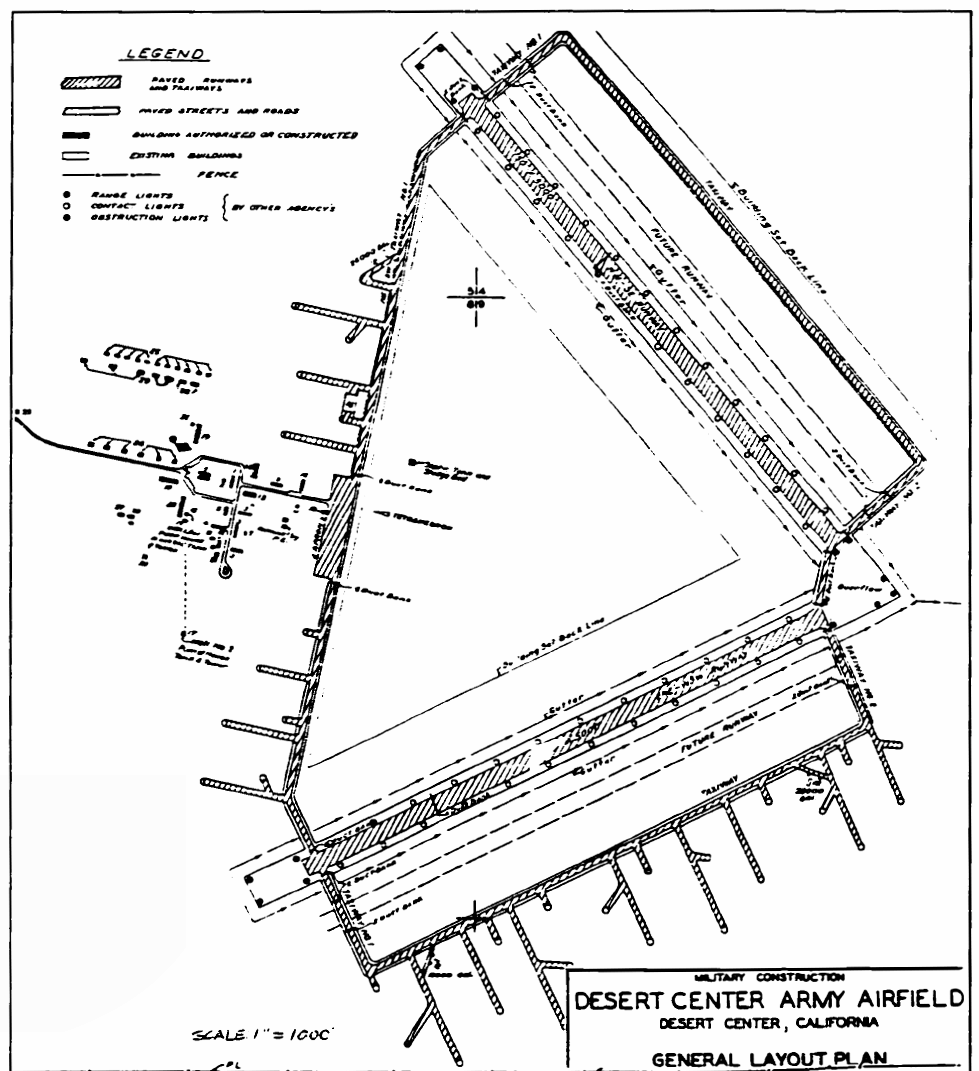
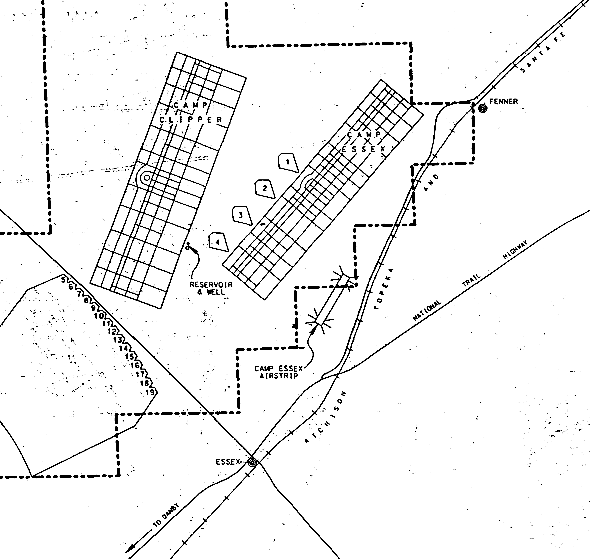
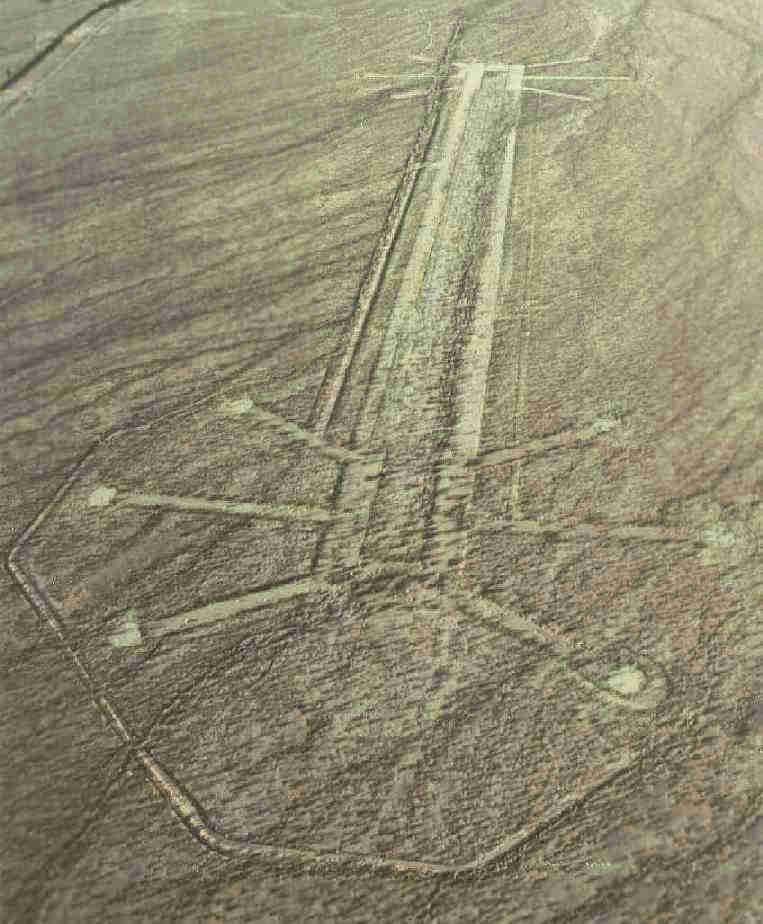
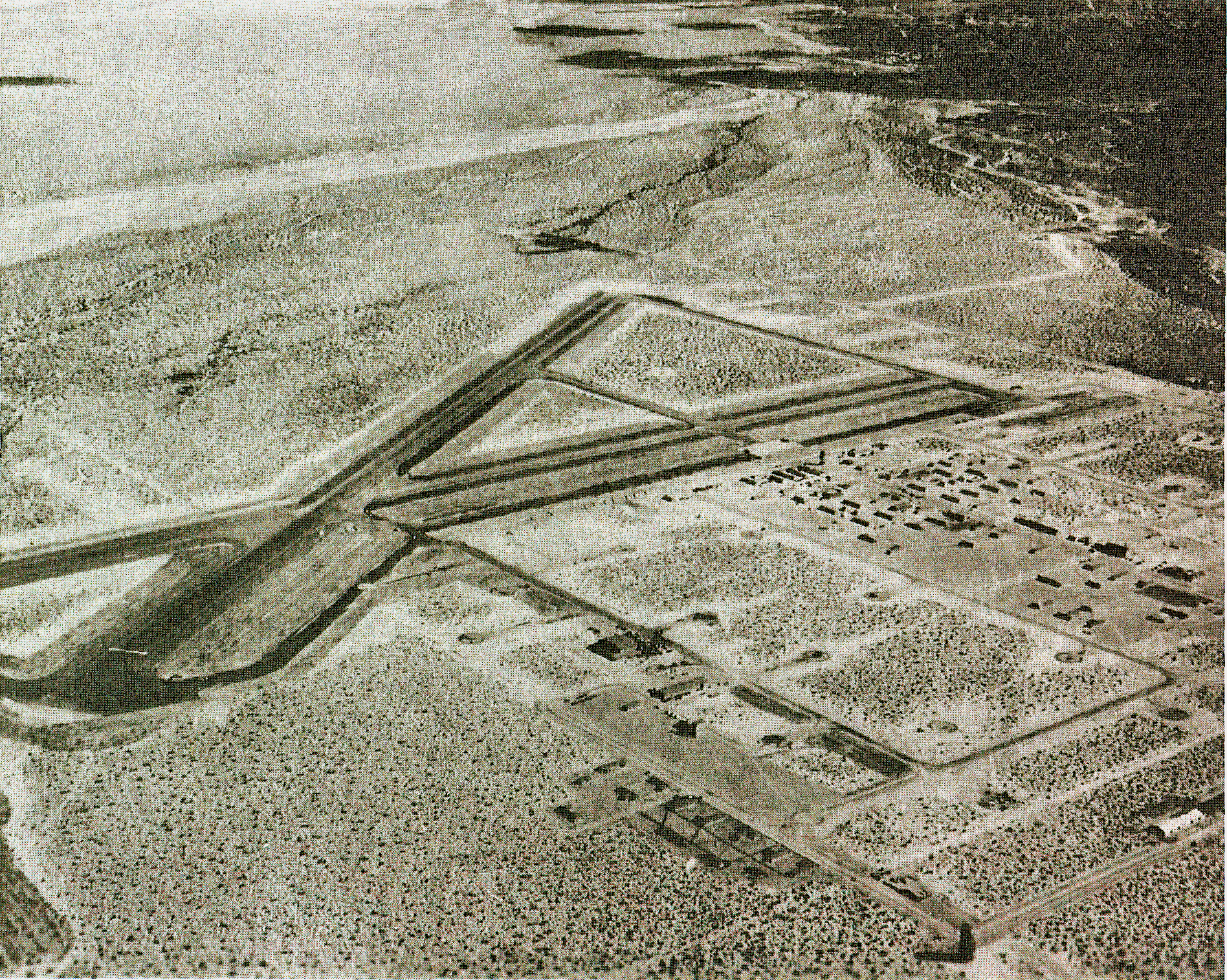
The tactical airdrome adjacent to Camp Essex and Camp Clipper remains a striking feature, with parallel runways and twelve widely spaced revetment areas. The hardstand pads at the revetment heads were intended for aircraft dispersal and ordnance safety, with spacing that reduced risk of cascading sympathetic detonation. Most buildings are gone, but the runway geometry, parking areas, and revetment pattern remain clearly visible from the air. The runway surface is now very rough with deep potholes and gullies, totally unsuitable for GA operations. Be vigilant for the 300-foot radio tower south of the airdrome.

12 Camp Essex
(N34º 47.91' / W115º 16.07') Inbound Mag Crs: 304º, altitude: 3,500’, 100 KIAS

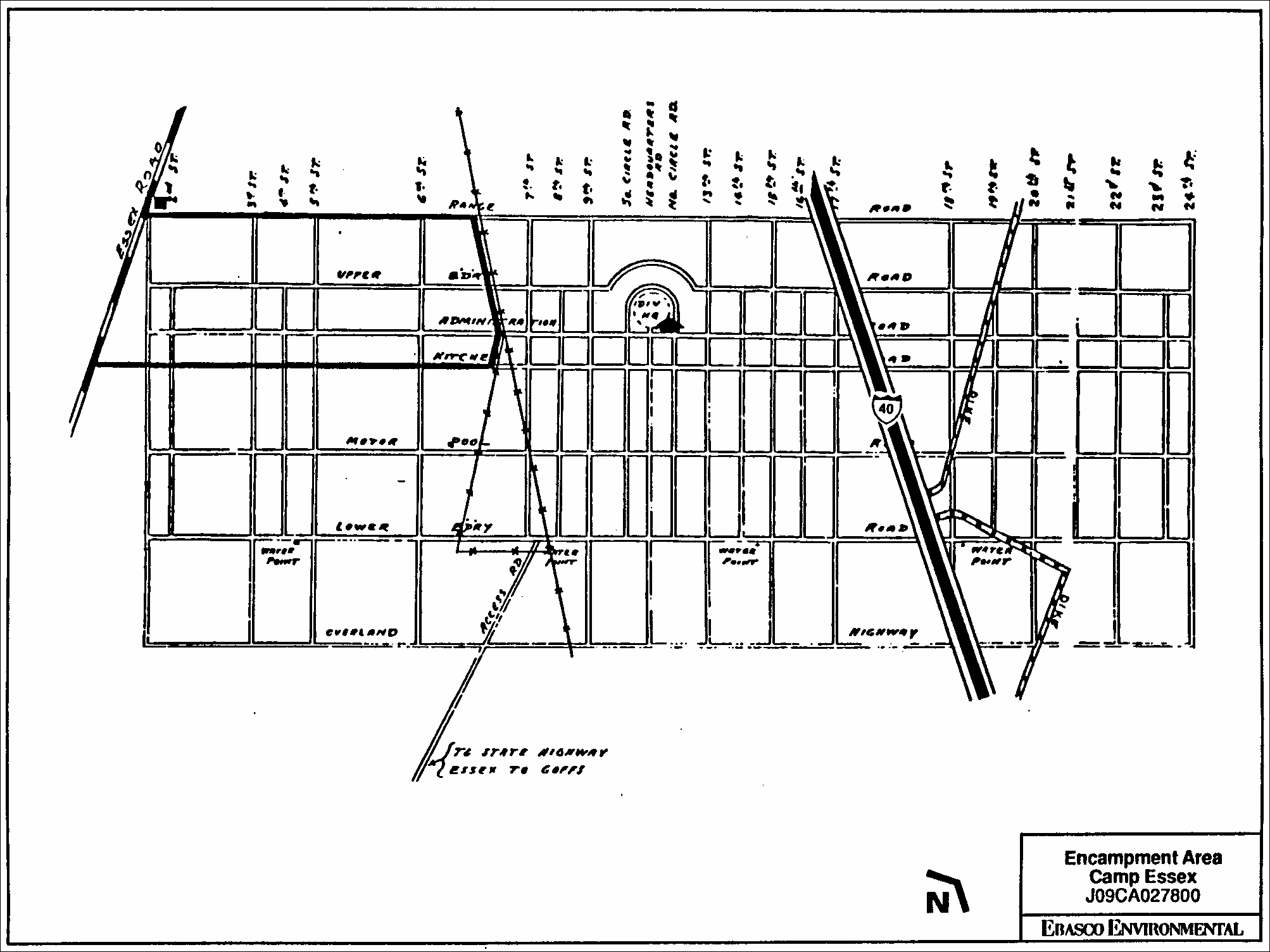
To the northwest of the airfield is Camp Essex, which was bisected by the construction of I-10. Circle the street pattern of the camp and look for the remaining features. The 50,000-gallon concrete reservoir is particularly noticeable. Camp Essex was located close to the small railroad towns of Essex and Fenner, and was bordered on the southwest by Essex Road. Facilities at the camp included 36 shower buildings, 191 latrine buildings, 149 pyramidal wooden tent frames, an outdoor theater, and a 500,000-gallon water reservoir.

13 Goffs
(N34º 56' / W115º 02') Inbound Mag Crs: 054º, altitude: 3,500’, 100 KIAS

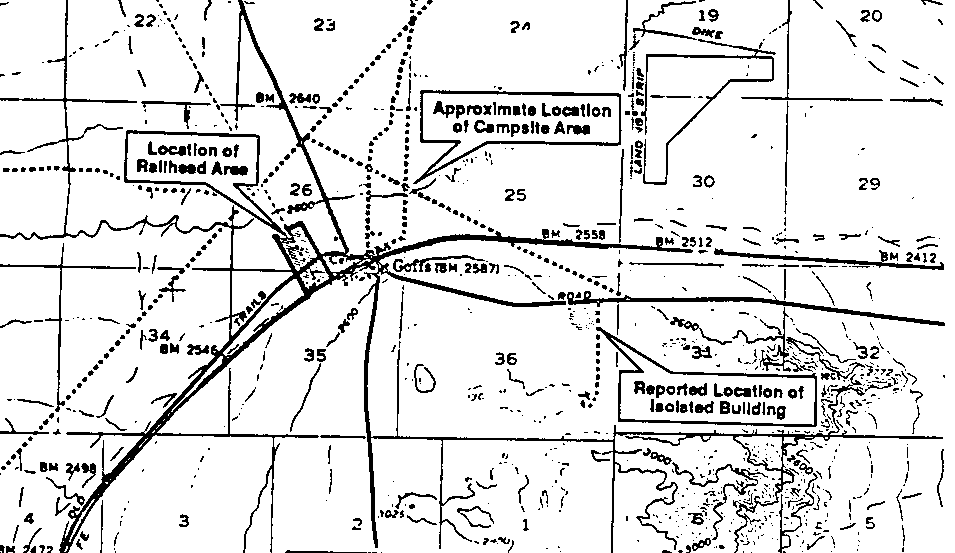
As you continue northeast from Camp Essex toward Goffs, follow the railroad and nearby roads as visual references. Evidence of Camp Goffs is subtler than at earlier sites: look for scattered foundations, disturbed pads, and linear remnants near and east of the former rail siding rather than a complete street grid.

The triangular former Goffs Intermediate Field, east-northeast of the camp area, is the most recognizable DTC-era feature from the air. Surface condition is unimproved and unmaintained; a landing attempt is likely unsafe and may involve trespass.

Nearby Camino Airstrip (CL29), owned by Metropolitan Water District of Southern California, is private-use (dirt) and requires prior permission. If fuel status is becoming a factor, plan Needles Airport (KEED): 100LL and Jet A are generally reported available; confirm same day with Paradise Aviation at (760) 326-5263. KEED official page: https://airports.sbcounty.gov/needles-airport/. Always verify current NOTAMs and Chart Supplement data before departure.

14 Ibis Airstrip
(N34º 58.54' / W114º 50.39') Inbound Mag Crs: 074º, altitude: 3,500’, 80 KIAS

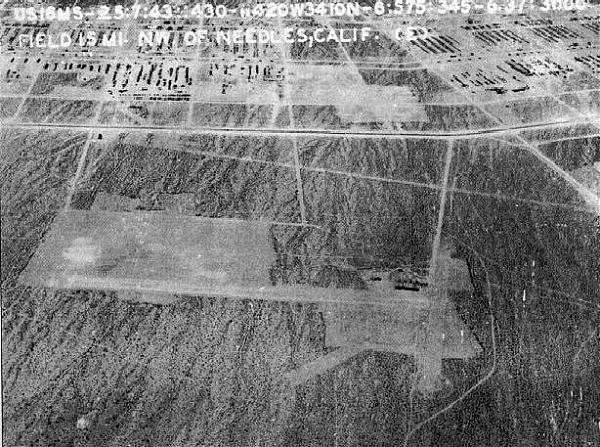
Located across Highway 95 to the west from the camp proper are the remains of Ibis airfield, historically a single unpaved north-south strip of about 4,500 feet. Freeman and later imagery describe the strip as barely recognizable today. Treat it as a historical overflight reference, not an intended landing destination. Numerous rock-lined walkways, refuse, and a few roads can still be found in this area.

15 Camp Ibis
(N34º 58.2' / W114º 49.4') Inbound Mag Crs: 038º, altitude: 3,500’, Cruise

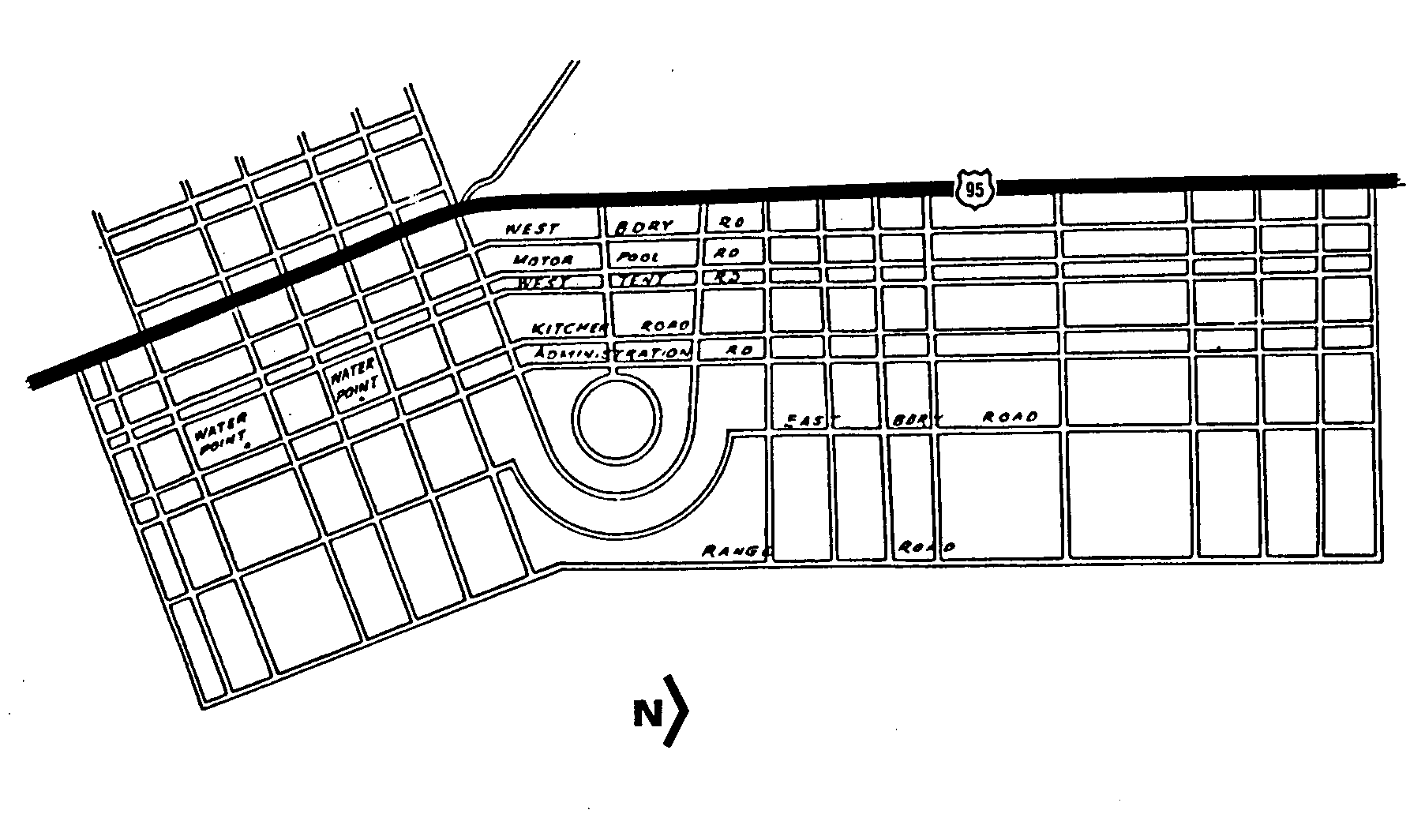
Continue from Ibis Airstrip toward the camp remains along U.S. Highway 95 in Piute Valley on the western foothills of the Dead Mountains. Camp Ibis has a unique bent street layout, aligned with the turn in Highway 95; none of the other DTC divisional camps share this pattern. The site remains relatively well preserved and easily recognizable from the air, with rock-lined walkways, pads, and a distinct large rectangular reservoir.

16 Laughlin
(N35º 09.28' / W114º 33.56') Inbound Mag Crs: 038º, altitude: 3,500’, Cruise

Leaving the railroad, continue northeast over the Dead Mountains toward Laughlin. The descent into the Mojave Valley toward the Colorado River reveals the resort corridor along the river. Use caution for prominent obstacles in the valley, including the approximately 504-foot stack on the west bank (top of the stack is near 1,219 feet MSL).

Laughlin/Bullhead International (KIFP) lies on the east bank with Runway 16/34 (8,500 ft) roughly paralleling the river. Contact Bullhead Tower inbound on 123.9 when in service, then contact Bullhead UNICOM on 122.85 for local ramp/hotel-shuttle coordination. After landing, follow Tower/Ground instructions and airport signage to transient parking; Taxiway A5 is a common route to the west-side GA/FBO parking area on the current Airport Diagram. Arrange hotel transportation with your destination resort or FBO before arrival, as shuttle availability can change.

The Waypoints and Coordinates:

If you cannot upload coordinates into your GPS and need to do so manually, the waypoints are listed below:

IDNameLatDLatMN/SLonDLonME/W
2CYNGCamp Young3340.4N11547.0W
L77Chiriaco Summit3339.9N11542.6W
L64Desert Center3344.9N11519.4W
2CCXMCamp Coxcomb3354.7N11516.4W
2CGRNCamp Granite343.3N1156.9W
2RICERice Army Airfield343.7N11448.9W
2CRCECamp Rice344.6N11445.7W
2CIMTCamp Iron Mountain346.0N1159.5W
2CDZDCadiz Dunes3421.5N11523.5W
2CDZSCadiz3431.2N11530.5W
2AMBYRoy's / Amboy (est.)3433.68N11544.93W
2AMBCAmboy Crater3432.7N11547.4W
2CCLPCamp Clipper3445.85N11516.06W
2ESXEssex Field3446.3N11513.2W
2CESXCamp Essex3447.91N11516.07W
2CGFSCamp Goffs3455.1N1154.2W
2GOFSGoffs Field3456.2N1154.1W
2IBISIbis Field3458.54N11450.39W
2CIBSCamp Ibis3458.2N11449.4W
KIFPLaughlin359.28N11433.56W

Tab Delimited Text

ID Name LatD LatM N/S LonD LonM E/W 2CYNG Camp Young 33 40.4 N 115 47.0 W L77 Chiriaco Summit 33 39.9 N 115 42.6 W L64 Desert Center 33 44.9 N 115 19.4 W 2CCXM Camp Coxcomb 33 54.7 N 115 16.4 W 2CGRN Camp Granite 34 3.3 N 115 6.9 W 2RICE Rice Army Airfield 34 3.7 N 114 48.9 W 2CRCE Camp Rice 34 4.6 N 114 45.7 W 2CIMT Camp Iron Mountain 34 6.0 N 115 9.5 W 2CDZD Cadiz Dunes 34 21.5 N 115 23.5 W 2CDZS Cadiz 34 31.2 N 115 30.5 W 2AMBY Roy's / Amboy (est.) 34 33.68 N 115 44.93 W 2AMBC Amboy Crater 34 32.7 N 115 47.4 W 2CCLP Camp Clipper 34 45.85 N 115 16.06 W 2ESX Essex Field 34 46.3 N 115 13.2 W 2CESX Camp Essex 34 47.91 N 115 16.07 W 2CGFS Camp Goffs 34 55.1 N 115 4.2 W 2GOFS Goffs Field 34 56.2 N 115 4.1 W 2IBIS Ibis Field 34 58.54 N 114 50.39 W 2CIBS Camp Ibis 34 58.2 N 114 49.4 W KIFP Laughlin 35 9.28 N 114 33.56 W
http://skytrail.info
DTC Patch

© Copyright: L. Dighera, Matt Bischoff, 2004-2026
All Rights Reserved: LDighera@att.net
DTCSkyTrail.info

QR Code