Camp Clipper
Camp Clipper was apparently a temporary camp, occupied by infantry divisions only. The 33rd Infantry Division occupied it after its construction in 1942, followed by the 93rd Infantry Division. The temporary facility was used as a transition camp for the more permanent Camp Essex to the east. When Camp Essex was completed, Camp Clipper was closed. Camp Clipper was used when one division was moving out and another was moving in, so that both units could be accommodated (as was the case with the 33rd and 93rd Divisions) (Meller 1946 :41 ; Figure 50). [1]
Camp Clipper was located in the eastern foothills of Clipper Mountain, west to northwest of Camp Essex, and north of the Essex Airfield. While Camp Essex was built predominantly on a north-south axis, Camp Clipper had a northeast-southwest orientation.
Camp Essex used the nearby Camp Clipper as a temporary staging area for divisions when one was moving in and another was moving out.
Current Condition
Little remains of Camp Clipper today, primarily because of the short life span of the camp and the fact that it was never a heavily used facility. Interstate 40 bisects the northern portion of the camp. Roads leading to the camp are barely discernible today, as most have eroded substantially and been overgrown with vegetation. Because it was more ephemeral than the other divisional camps, it is believed that little remains to mark the camp today.
The Bureau of Land Management visitor page identifies Camp Clipper at 34.764122, -115.267731. See the official reference here: Camp Clipper Divisional Camp - Patton (BLM).
Mitchell Caverns Recollections
In this first-person account, Jack Mitchell of Mitchell Caverns describes what happened when Camp Clipper abruptly brought thousands of troops into his immediate area. He recounts tense first encounters, practical problem-solving with Army officers, and how his family adapted by turning military demand into structured visits and support for soldiers. The narrative offers a vivid civilian-ground perspective on daily life and person-to-person dynamics during Desert Training Center operations.
Read the scanned multi-page story below. Click or tap page 1 to begin, then use Next Page to continue.
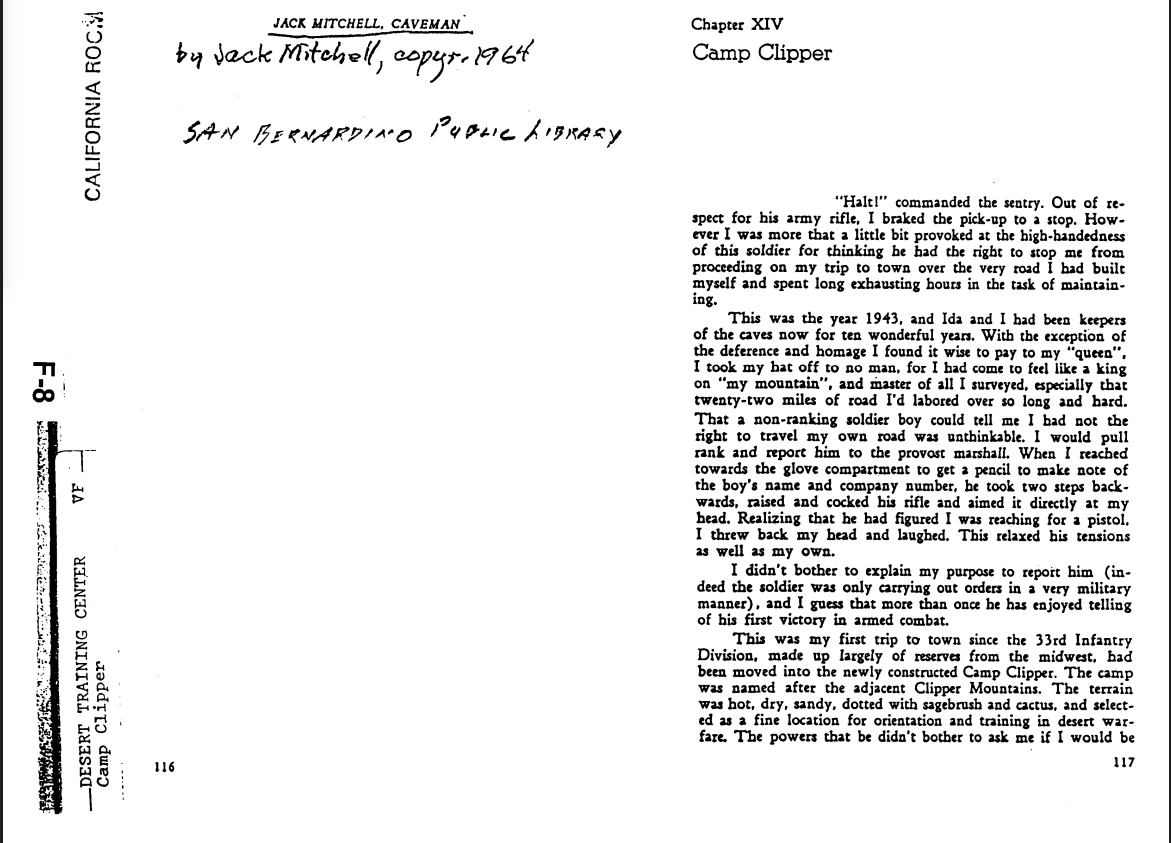
Tap the image to start reading.
Camp Clipper, a temporary camp, was located adjacent to the west side of the Camp Essex encampment area on the site formally acquired for Camp Essex. Camp Clipper was occupied by the 33rd Infantry Division before Camp Essex was prepared.
On 13 December 1943, the U.S. Department of the Interior transferred, by means of a use permit, 21,537.78 acres to the War Department in lieu of a formal real estate directive. An additional 8,998.72 acres was granted by eight other permits. No documentation pertaining to these permits could be found. Therefore, the dates and parties associated with these permit acquisitions cannot be determined. However, they were most likely secured from the State of California, the Southern Pacific Company and other private landowners between 1942 and 1943. Thus, a total of 30,536.50 acres was acquired for Camp Essex. Previous to the formal acquisition of Camp Essex, a portion of the total area was known as Camp Clipper, J09CA701000. No formal records could be found regarding the acquisition or relinquishment of Camp Clipper, thus Camp Clipper is a duplicate and is covered under Camp Essex.
14 firing ranges were located on the site, to the west of the Camp Essex encampment area, on the abandoned Camp Clipper encampment area. [US Army Corps of Engineers]